Saturday, August 15, 2009

Sivini - Part II: Seek Peace and Pursue It

Stories from the McFarlands ( by Bruce, from his 20008 Wycliffe speaking tour.)

" But the wisdom that comes from heaven is first of all pure;
then peace-loving, considerate, submissive, full of mercy and good fruit, impartial and sincere.
Peacemakers who sow in peace raise a harvest of righteousness."

-- James 3:17-18

At Christmastime 2006 in the town of Kainantu, before Sivini became a Christian, there was some fighting between two clans of the Kamano people. An AK-47 type gun was used in the fighting. Eight people were shot and three died. The Kamano people reckoned it was Sivini’s Usarufa people that provided the gun. So the Kamano were obligated to get them back.


In early June 2007, after Sivini became a Christian, an Usarufa public motor vehicle ran out of fuel while traveling on the road through Kamano territory. For the Kamano who had lost loved ones in the fight at Christmastime 2006, this was seen as a golden opportunity to get even with the Usarufa for the killing they were responsible for. So a group of Kamano people attacked the Usarufa using bush knives and guns. Of the five young men that were on that public motor vehicle two were able to run away without getting hurt, but the three others were shot. Of those three, two were wounded, but one, a man from the Usarufa village of Moife, was killed on the spot.


The next day many Usarufa people gathered around their fighting leader, Sivini. They wanted to get the warriors together to go take care of the attackers. Sivini wanted them to stop talking about fighting back. But what could he do now? Everyone was looking to him. What he says goes. He called six men to him and set out to talk with the Kamano leaders. Three of the men were carrying guns.


On the way there he began to feel pain coming to his stomach. These were the same feelings he used to get before a fight. Whenever he got this pain, people always died. So, in front of the men he got on his knees and started to pray, “God you know I am a changed person. You know I am not going to fight but I go for peace now. Please stop this pain so no one will die.” He felt the pain instantly go away.


Then he put some special leaves on the guns. Through this old, cultural custom he was showing the Kamano people that, even though the Usarufa people had guns, they were coming in peace.


Sivini chose to talk with some Kamano Elders at a place called Amboi. Amboi was where, not too long before this, a peace treaty had been signed between the Usarufa and Kamano people.


Sivini told the elders that the people from the village of Moife did not want to fight. He said, “Go back and tell all the Kamano people that we will not be paying them back.” Sivini went on to tell them that he had killed many Kamano people, but God has changed his life. He told his testimony of how he confessed his sin to God and that Jesus was now his Lord. He shared how he is now working with a Bible translation team.


Later, back in the village, the other men told everyone what had happened. People were shocked that Sivini told the Kamano that he had killed some of them and admitted that he was the key person to plan the attacks. His people said, “You shouldn’t have said that; now they will come and kill you.”


Sivini's response will warm your heart. Sivini told them, “It is OK if someone kills me, for I have accepted Jesus now and am ready to die if He wants me to. I have confessed everything to God, so I am not afraid.”


It is known that Sivini plays a big role amongst the Usarufa people. If Sivini says to fight, they all will fight, but if he says not to, they will respect that. Both Kamano and Usarufa people everywhere are asking, “What has made the big change in Sivini's life?”

Saturday, August 8, 2009

Sivini - Part I: Swords into Plowshares

Stories from the McFarlands ( by Bruce, from his 20008 Wycliffe speaking tour.)

"Therefore, if anyone is in Christ,

he is a new creation;

the old has gone, the new has come!"

-- 2Corinthians 5:17

One day in mid-2007, Sivini, the feared warlord of the Usarufa people came to Ukarumpa looking for farm equipment. Unbeknownst to him, at the same time there was a Translators Training Course ready to begin at Ukarumpa. The purpose [of the workshop] is to teach … translation teams the skills they need to work independently to translate God’s Word into their own language and also to become translators for other languages in PNG. Men from Sivini’s language group were to be a part of this workshop, but some of them were not able to come. Since they needed more participants from the Usarufa language, and Sivini was there at Ukarumpa, they invited him to join them in the workshop. When Sivini agreed, he had no idea that this was the hand of God working in his life … so that he could hear God’s message of salvation!


The course began and the intense study and translation of God’s Word gave Sivini a new understanding of who God is and taught him that he could have a relationship with Him.


When the students were reading the story in Genesis about Cain killing Abel and Abel’s blood calling out to God from the ground, the words pierced Sivini’s heart. He felt as if the blood of those he had killed was calling out to God from the ground.


You see, Sivini is a leader in his community and the fight commander for the Usarufa people. When someone in his village is attacked by people in a neighboring group, it is his responsibility to lead Usarufa men in seeking revenge. In this way he had killed many people. There were many times when bullets should have caught him, but they did not. For this reason, people from Sivini’s village, both young and old, respect him.


But when the students were translating the story of Cain and Abel, God spoke to Sivini’s heart. He knew he had been wrong and he wanted to be clean from his past. The next Sunday at the Pidgin-language church service in Ukarumpa, Sivini went forward to repent of his past and to ask for prayer. God lifted the burdens he had carried for many years. David Wake, the Summer Institute of Language Advocate for his language group, says even Sivini’s looks have changed since he accepted Jesus because now he no longer carries the weight of the guilt from his past. Who but Jesus could do such a wonderful thing?


Sivini knows he cannot continue as the fight leader in his village. Instead, he wants to spend his time helping the translation team in turning God’s “talk” into the Usarufa language, so that his people can know the Lord, too. He wants them to find peace, freedom and forgiveness from sin – just like he has!

Wednesday, July 22, 2009

Good Home Cookin'

(From Aretta Loving’s book, Slices of Life: From the Plate of a Bible Translator)


"I particularly enjoyed watching a woman, home early from her taro garden, prepare aboya. Sitting comfortably on the ground, she first peels taro tubers with a homemade knife: a razor-sharp piece of bamboo. Then with a thorny tree root she grates the taro. Water is added and brown hands became snow white as they work the taro-water mixture into a mush. The mush is spread onto a long, flattened bamboo tube, then bedecked with whatever delicacies she has on hand. Smoked rat, smoked frog or large, white witchetty grubs fresh from the foest are favorites. Finally, the woman chews up ginger rot and homemade salt, then spews the mixture onto the spread-out mush. The smashed bamboo is then rolled up and stuck inside a still larger bamboo tube. The long tube is laid over an open fire and gradually rotated and pushed through the fire. To make sure the tube stays on the fire long enough to cook the aboya, but not long enough to burn through the tube, is an art. And Awa women excel at this art!"

In 1959, Mrs. Loving and her husband Ed went to a remote village in PNG to live and work with the Awa people, to learn their language and to translate the Bible into it.

(Note: we won't be eating at that restaurant.)

Saturday, July 18, 2009

Two Missionaries and Two Babies

Stories from the McFarlands (by Paula; May, 2009)


This morning as I sat outside in my haus win (rectangular house made out of bush materials with a grass roof and no walls), spending time with the Lord, I read Psalm 78 and I began to remember some of the praiseworthy deeds of the Lord that have happened in our lives since our November 2008 newsletter.


God gave us several opportunities to help our Papua New Guinean friends in major ways.


One Saturday night in November we got word that Iti was in labor. We didn’t know if the hospital was open. We drove to the river. Iti walked through the river in the dark, in labor—pains about five minutes apart, climbed into our car and we were off! Yes, the hospital was open! Praise the Lord! It actually took until Sunday afternoon before little Bruce was born. Imagine this…no mattresses and no water at the hospital! We provided both for Iti.


A month later Weti, our PNG pastor’s wife, was ready to have her baby. We were also able to help get them to the hospital and meet some of their physical needs as well as spiritual as we prayed earnestly for the arrival of their son, Wesley. It was a difficult labor but the Lord was gracious and protected both baby & mom.

Every verse. Every tongue. Every task.

Why the McFarlands Are in PNG

“Every day, Bible translators the world over find themselves pulled away from their primary responsibility—translating the Word of God—to deal with tasks that…can be accomplished by others.” *

Since 1967, Wycliffe Associates has mobilized lay people to partner with Bible translators around the world, freeing up thousands of hours each day to accelerate Bible translation ministry. Every year, thousands of Wycliffe Associates volunteers use their God-given talents and skills to support translators in the field.” * Such is the role of our friends, Bruce and Paula McFarland, who serve as teachers in the missionary community of Ukarumpa, Papua New Guinea.

Why is Bible translation so important? The apostle Paul puts it simply: “faith comes by hearing, and hearing by the word of God.” (Romans 10:17)
How, then, can they call on the one they have not believed in? And how can they believe in the one of whom they have not heard? And how can they hear without someone preaching to them? And how can they preach unless they are sent? As it is written, "How beautiful are the feet of those who bring good news!" (Romans 10:14-15)
By their work as support missionaries, Bruce and Paula are helping to bring the good news of Jesus Christ to the tribal people of PNG, so that they, too, may hear, believe and be saved.
* from Wycliffe Associates website: www.wycliffeassociates.org

Monday, June 29, 2009

Who are Papua New Guineans?


The indigenous population of Papua New Guinea is one of the most heterogeneous in the world. PNG has several thousand separate communities,most with only a few hundred people. Although the country has three official languages (English, Tok Pisin, and Motu), its more-than 800 other languages add to the country's vast cultural diversity. Its history has been marked by low-scale tribal conflict among the neighboring communities and the advent of modern weapons and migration into urban areas has magnified the impact of this problem.


Population Facts:


Population: 6,057,263 (July 2009 est.)

country comparison to the world: 107


Median Age: 21.7 years


Urban Population: 12% of total population (2008)


Life Expectancy: total population: 66.34 years

country comparison to the world: 160


Ethnic Groups:
Melanesian, Papuan, Negrito, Micronesian, Polynesian


Language: The three official languages are English, Tok Pisin, and Motu; there are approximately 860 other languages


Literacy: total population: 57.3%


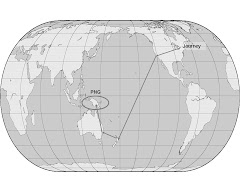
Where In the World is Papua New Guinea?


Papua New Guinea (PNG) is part of Oceania, a group of islands in the South Pacific Ocean. Situated about 100 miles north of Australia, PNG shares the island of New Guinea with Indonesia. It lies just south of the equator and west of the international date-line. The island is part of a great arc of mountains stretching from Asia, through Indonesia and into the South Pacific. Part of the Pacific "Ring of Fire", its mountains include active volcanoes.

PNG boasts a tropical climate with slight temperature variations and seasonal monsoons. In addition to its volcanism, the island is subject to frequent earthquakes, mud slides, and tsunamis.