Showing posts with label About PNG. Show all posts

Thursday, September 3, 2009

Husat i save long tok Inglis? (Does anyone here speak English?)

Although there are over 800 indigenous languages in Papua New Guinea, Tok Pisin (or Melanesian Pidgin English) is one of the country’s three national languages, but it is hardly spoken universally in PNG. Following are some basic English phrases translated into Tok-Pisin. We’ll be using some of these, to be sure, but we’ll also keep a translator close at hand.


Englis-to-Tok Pisin Translations


Hello = Gude (goo-DAY)

Hello (informal) = Hi. Hai. (HIGH)

How are you? = Yu stap gut? (you stahp goot?)

What is your name? = Husat nem bilong yu? (HOO-zaht naym bee-LONG yoo)

My name is _____. = Nem bilong mi emi _____. (naym bee-LONG mee em ee ______.)

Nice to meet you. = Gutpela long bungim yu. (GOOT-peh-lah long BOONG-im YOO)

Please. = Plis (plees)

Thank you. = Tenkyu (TENK-yoo)

You’re welcome. = Nogat samtin. (NO-gaht sahm-ting)

Yes. = Yes. (YESS)

No. = nogat. (no-GAHT)

Excuse me. = Skius. (skyooz)

I’m (very) sorry. = Mi sori [tumas]

Goodbye = Gutbai (GOOT-bigh)

Goodbye (informal) = Lukim you bihain. (LOO-keem yoo bee-HIGHN)

I can’t speak tok Pisin [well]. = Mi no save[gut] long Tok Pisin. (mee noh SAH-vay long tohk pisin.)

Do you speak English? = Yu save long tok Inglis, a? (Yoo SAH-veh long tohkING-glis?)

Is there someone here who speaks English? = Husat i save long tok Inglis? (hoo-ZAHT ee SAH-veh long tohk ING-glis?)


PNG words for the fruits of the Spirit


Love: laikim tru = love or like very much

Joy: amamas = joy or happiness

Peace: bel isi = restful emotions or being in a state of rest or peace

Patience: no belhat kwik = not getting angry quickly

Kindness: helpim ol man = helping others

Goodness: makim gutpela pasin = do good things, or the habit of doing good

Gentleness: I stap isi = being in a state of rest or peace

Faithfulness: wokabaut stret oltaim = walking straight all the time

Self Control: daunim laik bilong olpela bel = down, or suppress the desires of your old self

Wednesday, July 22, 2009

Good Home Cookin'

(From Aretta Loving’s book, Slices of Life: From the Plate of a Bible Translator)


"I particularly enjoyed watching a woman, home early from her taro garden, prepare aboya. Sitting comfortably on the ground, she first peels taro tubers with a homemade knife: a razor-sharp piece of bamboo. Then with a thorny tree root she grates the taro. Water is added and brown hands became snow white as they work the taro-water mixture into a mush. The mush is spread onto a long, flattened bamboo tube, then bedecked with whatever delicacies she has on hand. Smoked rat, smoked frog or large, white witchetty grubs fresh from the foest are favorites. Finally, the woman chews up ginger rot and homemade salt, then spews the mixture onto the spread-out mush. The smashed bamboo is then rolled up and stuck inside a still larger bamboo tube. The long tube is laid over an open fire and gradually rotated and pushed through the fire. To make sure the tube stays on the fire long enough to cook the aboya, but not long enough to burn through the tube, is an art. And Awa women excel at this art!"

In 1959, Mrs. Loving and her husband Ed went to a remote village in PNG to live and work with the Awa people, to learn their language and to translate the Bible into it.

(Note: we won't be eating at that restaurant.)

Monday, June 29, 2009

Who are Papua New Guineans?


The indigenous population of Papua New Guinea is one of the most heterogeneous in the world. PNG has several thousand separate communities,most with only a few hundred people. Although the country has three official languages (English, Tok Pisin, and Motu), its more-than 800 other languages add to the country's vast cultural diversity. Its history has been marked by low-scale tribal conflict among the neighboring communities and the advent of modern weapons and migration into urban areas has magnified the impact of this problem.


Population Facts:


Population: 6,057,263 (July 2009 est.)

country comparison to the world: 107


Median Age: 21.7 years


Urban Population: 12% of total population (2008)


Life Expectancy: total population: 66.34 years

country comparison to the world: 160


Ethnic Groups:
Melanesian, Papuan, Negrito, Micronesian, Polynesian


Language: The three official languages are English, Tok Pisin, and Motu; there are approximately 860 other languages


Literacy: total population: 57.3%


Where In the World is Papua New Guinea?


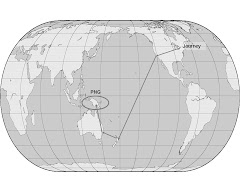
Papua New Guinea (PNG) is part of Oceania, a group of islands in the South Pacific Ocean. Situated about 100 miles north of Australia, PNG shares the island of New Guinea with Indonesia. It lies just south of the equator and west of the international date-line. The island is part of a great arc of mountains stretching from Asia, through Indonesia and into the South Pacific. Part of the Pacific "Ring of Fire", its mountains include active volcanoes.

PNG boasts a tropical climate with slight temperature variations and seasonal monsoons. In addition to its volcanism, the island is subject to frequent earthquakes, mud slides, and tsunamis.